
Ever wondered how AI agents can make decisions that feel almost human?
Not just answering questions or generating text, but actually doing stuff. Scheduling meetings, ordering lunch, booking travel, or navigating complex software without breaking a sweat?
That’s where Large Action Models (LAMs) step in. They’re not just the next big thing in artificial intelligence; they’re the very heart of autonomous AI agents.
But here’s the thing: they’re only as smart as the actions they’ve been trained to understand. And that’s where data annotation plays a surprisingly big role.
Let’s unpack what makes LAMs tick, why they matter, and how companies like Infolks are training these intelligent workhorses with rock-solid data.
What Are Large Action Models (LAMs)?
Think of a LAM as a brain that understands not just words, but what to do next.
While Large Language Models (LLMs) like GPT or Claude focus on understanding and generating text, LAMs focus on taking actions. These could be clicking a button in an app, executing a command in software, or even physically moving a robot arm.
LAMs are trained to understand:
- What actions are possible in a given environment?
- What sequence of actions achieves the desired goal?
- How to adapt when things don’t go as planned?
In short, they make AI useful, not just smart.
Real-World Examples of LAMs in Action
To get a better grip on this, let’s look at where LAMs are quietly changing the game.
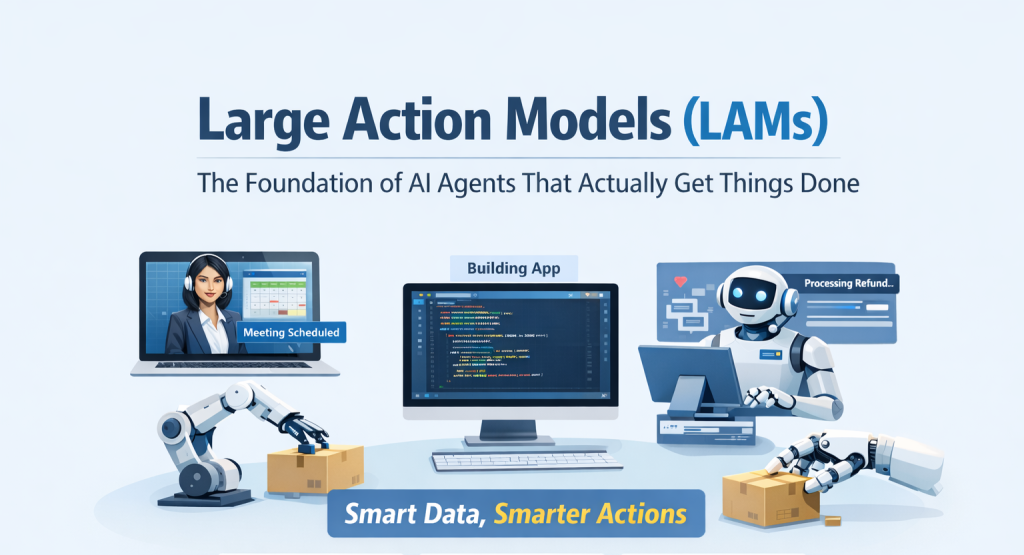
1. Virtual Office Assistants
Startups are building agents that can read your emails, summarize priorities, and auto-schedule meetings without asking for each step. LAMs are responsible for this autonomy.
2. AI for Developers
Some platforms allow developers to describe what they want, and the AI agent builds it. The LAM behind it interprets the intent and executes code-level actions.
3. Customer Support Agents
These agents navigate support dashboards, fetch past orders, and initiate refunds based on user queries without human help. Every smart click starts with a LAM
4. Logistics and Warehousing
Robotic arms that sort packages or pick items for delivery use LAMs to learn real-world routines, from shelf recognition to movement control.
LAMs don’t just understand language, they bridge it with real-world or software-based execution.
Why Is Data Labeling Vital for LAM Training?
Now here’s the catch. For a LAM to understand an action, someone must first label it correctly.
At Infolks, we worked on a project involving an AI agent trained to navigate e-commerce dashboards, adding items, modifying prices, and generating invoices. Each step involved detailed data annotation, screen recording every action, labeling it with the correct intent, and tagging screen elements for clarity.
Without this ground truth data, even the smartest model is lost.
LAMs rely on:
- Tagged sequences of user interactions (clicks, hovers, scrolls)
- Audio-visual mapping (for robots or physical actions)
- Detailed intent annotation (why a step was taken)
Our team at Infolks uses LabelMore, our internal tool, to handle such multi-format, complex data. Whether it’s annotating UI actions or aligning spoken commands with robotic gestures, we cover it all with multi-level quality checks.
LAMs vs LLMs: What’s the Difference?
This confusion is common, so let’s clear it up:
| Feature | LLM (Large Language Model) | LAM (Large Action Model) |
| Focus | Text generation & understanding | Task execution & interface interaction |
| Example Use | Writing content, answering questions | Clicking buttons, booking tickets |
| Training Data | Books, articles, conversations | Action logs, software usage, commands |
| Limitation | Can’t act autonomously | Still needs lots of labelled action data |
Together, LLMs and LAMs make a dream team, understanding and doing. But on their own, they serve different needs.
How Businesses Can Prepare for the LAM Era
LAMs aren’t just for Big Tech. Startups, SaaS platforms, and even freelancers can benefit. Here’s how to get ahead:
1. Identify Repeatable Tasks
Look for tasks that your team repeats daily, like invoice generation or calendar management. Perfect for LAM automation.
2. Record, Label, Learn
Start recording how tasks are done. Tools like Loom or OBS help. Work with data labeling partners like Infolks to annotate them properly.
3. Integrate Gradually
Use LAM-powered agents for support tickets or form filling before expanding to more complex workflows.
4. Prioritise Security
LAMs often access sensitive systems. Use GDPR-compliant, ISO-certified vendors for data handling and model training.
Why Infolks is the Ideal LAM Training Partner
Training a LAM isn’t just about feeding it data, it’s about feeding it the right data.
With years of experience, Infolks has worked across domains: logistics, retail, healthcare, and SaaS. We understand what high-quality data looks like and how poor annotation can wreck model performance.
We offer:
- Action flow labeling (UI/UX events)
- Multimodal annotation (speech + actions)
- 3D & robotic command labeling
- Triple-check QA workflows
- 24/7 project support and flexible pricing
Want to see how it works? We offer free demo sets and trial projects. No obligations, just clarity.
Final Thoughts: LAMs Aren’t the Future. They’re the Now
While everyone’s talking about ChatGPT and text generators, the smartest businesses are training agents that can act, not just talk.
Large Action Models are already powering the next generation of automation, productivity, and real-world AI. But they won’t work without accurate, labeled, diverse datasets.
Whether you’re an AI researcher, product team, or business owner, the best time to understand LAMs was yesterday. The second-best time is now.
Want Smarter AI Agents? Start with Smarter Data.