
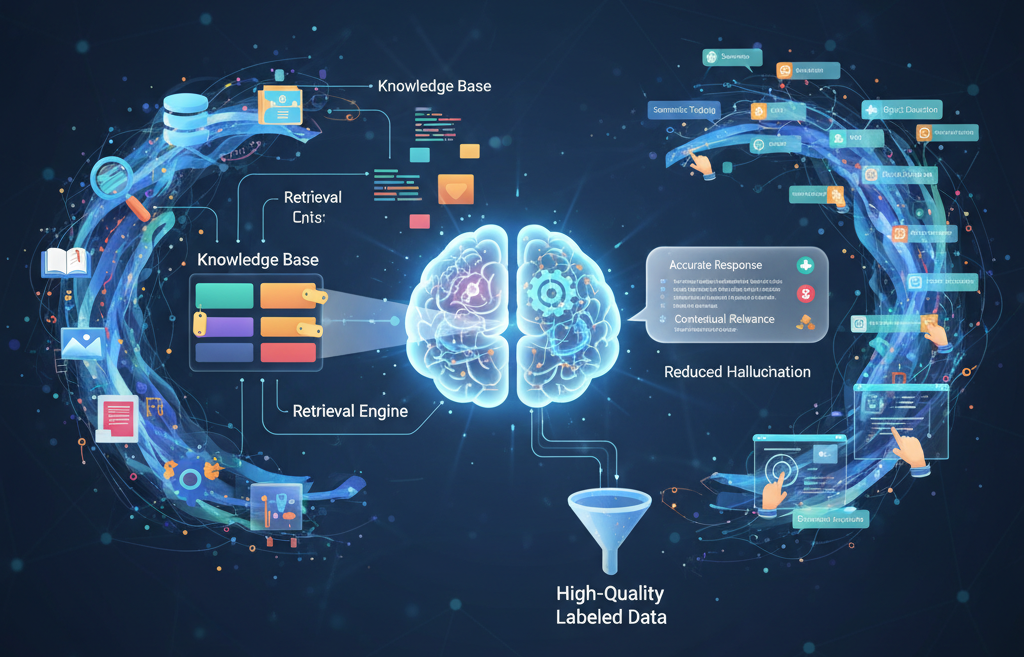
Artificial Intelligence (AI) has revolutionized various industries, from customer service and healthcare to finance and retail. One of the key advancements driving AI’s capabilities is Retrieval-Augmented Generation (RAG), an innovative approach that enhances AI models by combining retrieval-based search with generative AI techniques. This hybrid method significantly improves the accuracy, reliability, and contextual relevance of AI-generated responses.
However, for RAG models to function effectively, they require high-quality, well-labeled training data. This is where data labeling plays a crucial role in ensuring the AI system retrieves and generates accurate, meaningful, and contextually rich responses. In this blog, we’ll explore how RAG works, its applications, and how data labeling services like Infolks contribute to its success.
Understanding Retrieval-Augmented Generation (RAG)
RAG is an advanced AI framework that enhances language models by combining retrieval and generative capabilities. Traditional generative AI models, like GPT-5, rely solely on pre-trained knowledge, which may become outdated or lack real-time context. RAG overcomes this limitation by:
- Accessing accurate information from external sources.
- Using the retrieved information to generate accurate and context-aware responses.
This process ensures that the AI system produces responses grounded in the most recent and relevant information, rather than relying only on static training data.
How Does RAG Work?

The RAG model operates in two main stages:
1. Retrieval Phase
- When a user inputs a query, the AI searches a pre-indexed knowledge base or database for the most relevant documents or data points.
- It uses advanced retrieval techniques like vector search, dense passage retrieval (DPR), or keyword-based search to identify relevant information.
2. Generation Phase
- The retrieved data is fed into a generative model (e.g., GPT, BERT, or T5) to generate responses grounded in up-to-date and relevant information.
- This ensures that the AI’s response is informed, contextually accurate, and grounded in real-world information.
By incorporating retrieval, RAG significantly reduces hallucination (the generation of false or misleading information), making it ideal for industries that require accuracy and reliability, such as healthcare, finance, and legal services.
Why RAG Needs High-Quality Data Labeling
For RAG models to retrieve and generate reliable responses, the underlying dataset must be structured, accurate, and well-labeled. Poorly labeled data can lead to irrelevant retrievals, biased responses, and misinformation. Here’s where accurate data labeling makes all the difference.
Key Ways Data Labeling Enhances RAG Models
- Improving Retrieval Accuracy
- Properly labeled data ensures that the AI retrieves the most relevant information from the knowledge base.
- Annotation techniques such as semantic tagging, named entity recognition (NER), and ontology-based categorization help in organizing and structuring data effectively.
- Reducing Bias and Hallucination
- Bias in training data can lead to skewed AI responses. High-quality labeling helps balance datasets and improve fairness in AI-generated content.
- Ensuring that only verified and high-quality data is used minimizes AI’s tendency to hallucinate.
- Enhancing Multi-Modal AI Understanding
- RAG models are not limited to text but can process images, videos, and audio data.
- Data labeling for multi-modal AI ensures that retrieval-based generation works effectively across different media types.
- Optimizing Data Indexing for Fast Retrieval
- Labeled datasets enable efficient indexing in retrieval mechanisms.
- This speeds up the search process and allows real-time response generation.
- Boosting Performance in Domain-Specific Applications
- In industries like healthcare, legal, and finance, domain-specific AI models require highly accurate and specialized labeled data.
- Annotated datasets help RAG models understand and retrieve industry-relevant information effectively.
Use Cases of RAG with Data Labeling
1. AI-Powered Customer Support
- Chatbots and virtual assistants using RAG can retrieve and generate contextually relevant responses to customer inquiries.
- Labeled customer interaction data improves response accuracy and personalization.
2. Healthcare and Medical Research
- RAG models assist doctors and researchers by retrieving medical literature, patient history, and clinical guidelines.
- Accurate medical data labeling, including symptom tagging and diagnostic annotations, ensures reliable AI-driven medical recommendations.
3. Financial Services & Risk Analysis
- AI systems using RAG can analyze real-time financial reports, stock trends, and risk assessments.
- Properly labeled transaction data improves fraud detection and market predictions.
4. Legal Document Analysis
- RAG models can retrieve legal cases, regulations, and precedents to assist lawyers in legal research.
- Labeling legal documents with entity recognition and case tagging improves retrieval efficiency.
5. Smart Content Creation & SEO Optimization
- RAG enhances AI-generated content by enabling fact-checking and the retrieval of relevant information.
- Labeled content metadata and semantic tagging ensure AI retrieves the most relevant sources.
How Infolks Provides High-Quality Data Labeling for RAG Models
At Infolks, we specialize in providing accurate, high-quality training datasets for AI models, including RAG-based systems. Our data labeling solutions ensure that AI-powered applications perform efficiently and generate precise, contextually aware responses.
Our Data Labeling Services for RAG Models
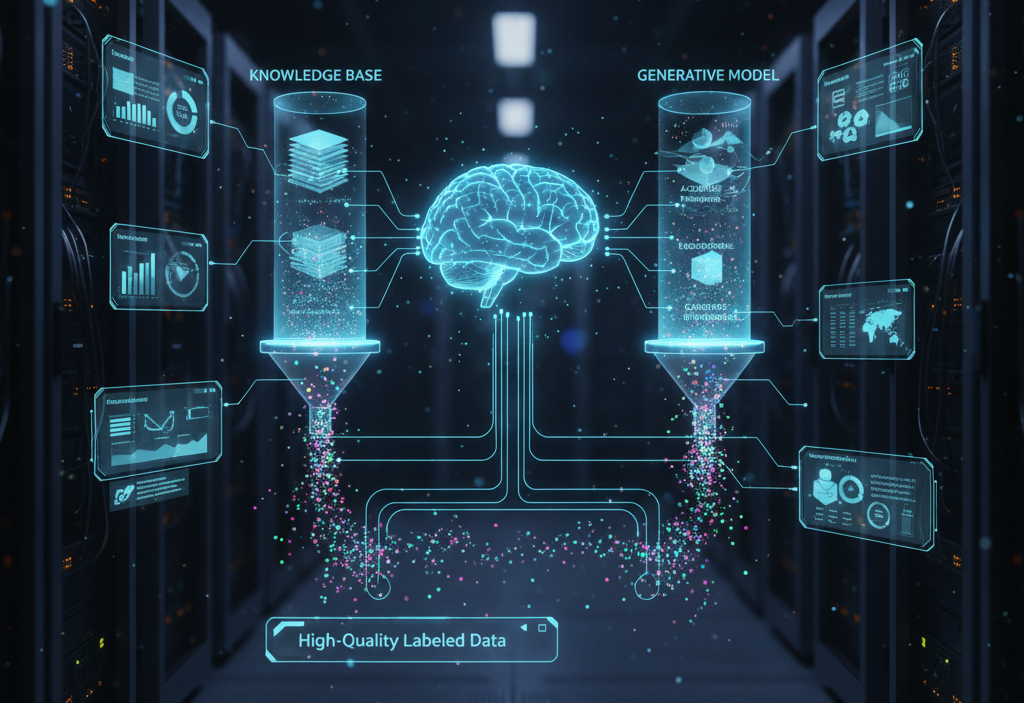
- Text Annotation: Named entity recognition (NER), entity linking, and document classification to improve text-based AI retrieval.
- Image and Video Annotation: Object detection, semantic segmentation, and bounding box labeling to enhance multi-modal RAG systems.
- Audio & Speech Recognition: Speaker identification, sentiment analysis, and emotion labeling for AI-driven voice assistants and chatbots.
- 3D Point Cloud Annotation: High-precision labeling for spatial AI applications, robotics, and autonomous systems.
- Domain-Specific Data Labeling: Industry-tailored annotations for healthcare, finance, legal, and retail AI applications.
Triple-level quality checks ensure precision at every stage. ISO 9001:2015 and ISO/IEC 27001:2022 certifications safeguard quality and data security. GDPR compliance reinforces ethical, responsible AI training data delivery.
Final Thoughts: The Future of RAG and Data Labeling
As AI continues to evolve, Retrieval-Augmented Generation (RAG) will play a crucial role in creating more accurate, reliable, and context-aware AI systems. However, the effectiveness of RAG largely depends on high-quality, well-labeled training data.
With expert data labeling services from Infolks, businesses can ensure that their AI models are trained with accurate, structured, and unbiased datasets, leading to improved performance, reduced errors, and enhanced real-world applicability.
Are you ready to boost your AI with high-quality labeled data? Partner with Infolks for precise, structured datasets that drive accuracy and efficiency.
Let’s build the future of AI together!