Artificial intelligence is no longer limited to a single chatbot that answers questions or generates content. Today’s AI is evolving into intelligent agents capable of planning tasks, making decisions, using tools, and solving problems with minimal human intervention.
But what happens when one AI agent isn’t enough?
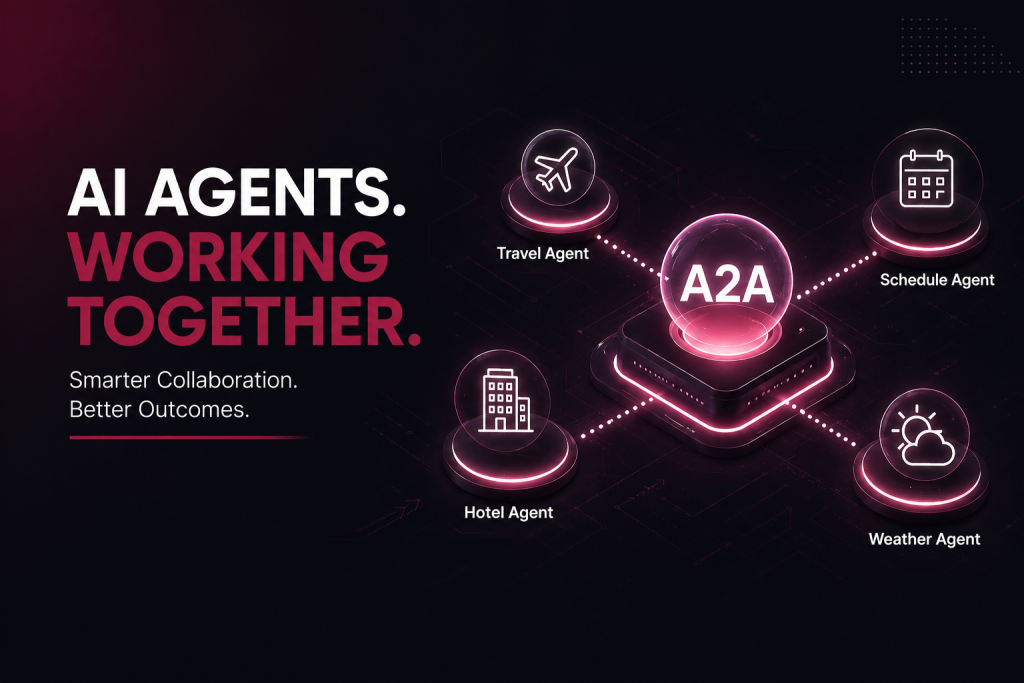
Imagine planning an international business trip. One AI agent books your flight, another secures your hotel, a third checks the weather forecast, and another organizes everything in your calendar. Instead of working independently, these AI agents collaborate to complete your trip planning seamlessly. Instead of one AI handling everything, multiple AI agents work together to complete the task faster and more efficiently.
This collaborative approach is known as agent-to-agent (A2A) communication, and it’s becoming one of the most exciting developments in enterprise AI.
What Is Agent-to-Agent (A2A) Communication?
Agent-to-Agent (A2A) Communication is the process by which multiple AI agents exchange information, coordinate tasks, and work together to achieve a common goal.
Rather than relying on a single AI system to perform every task, each agent specializes in a specific responsibility and communicates with other agents as needed.
Think of it like a hospital. A doctor diagnoses the patient, a nurse monitors recovery, a pharmacist prepares medication, and a lab technician performs tests. Each professional has a specialized role, but together they deliver better patient care.
AI agents operate similarly. By collaborating instead of working independently, they can solve more complex problems with greater speed and accuracy.
How Does A2A Communication Work?
A typical agent-to-agent workflow has these steps:
1. A User Makes a Request
The process begins with a user’s request, such as generating a business report or planning a supply chain.
2. A Coordinator Agent Breaks Down the Task
A central AI agent analyzes the request and divides it into smaller tasks.
3. Specialized Agents Perform Individual Tasks
Each AI agent focuses on its area of expertise.
For example:
- One agent retrieves customer data.
- Another analyzes sales trends.
- A third creates charts.
- A fourth writes the final report.
4. Agents Share Information
The agents exchange results, validate information, and coordinate their progress.
5. Final Response Is Delivered
The completed work is combined into one accurate and meaningful response for the user.
This collaborative workflow enables AI systems to solve tasks that would be difficult for a single agent.
Benefits of Agent-to-Agent Communication
As businesses adopt AI at scale, A2A communication offers several advantages.
Faster Decision-Making
Multiple AI agents can work simultaneously, reducing the time required to complete complex tasks.
Better Specialization
Each AI agent focuses on a specific responsibility, improving overall performance and accuracy.
Greater Scalability
Organizations can add new agents for different functions without redesigning the entire AI system.
Improved Automation
AI agents can communicate and complete workflows with minimal human intervention.
Increased Reliability
Collaborative decision-making helps reduce errors by allowing agents to validate information before producing results.
Real-World Applications
Agent-to-agent communication is already transforming industries.
Healthcare
One AI agent analyzes medical images, another reviews patient history, and another recommends treatment options for healthcare professionals.
Customer Support
Different AI agents verify customer identities, retrieve account details, answer questions, and escalate complex cases when necessary.
Finance
AI agents detect fraud, assess financial risk, process transactions, and generate compliance reports collaboratively.
Software Development
One AI agent writes code, another reviews it for security issues, while another generates documentation and performs testing.
Supply Chain Management
Multiple AI agents monitor inventory, predict demand, optimize delivery routes, and track shipments in real time.
Challenges of A2A Communication
While A2A communication offers many advantages, it also introduces new challenges.
Organizations must address several challenges, including ensuring secure communication between AI agents, maintaining data consistency across systems, managing access permissions, coordinating tasks among multiple agents, resolving decision conflicts, and minimizing response latency. Overcoming these challenges is essential for building efficient, secure, and reliable Agent-to-Agent (A2A) communication systems.
These challenges highlight the need for reliable infrastructure and high-quality data.
Why Data Quality Matters
Successful AI collaboration depends on more than communication.
Every AI agent relies on accurate information to make decisions.
If the underlying data is incomplete, inconsistent, or poorly organized, AI agents may misunderstand requests, retrieve incorrect information, or produce unreliable results.
This makes high-quality training data one of the most important factors in building dependable multi-agent AI systems.
How Data Labeling Powers Multi-Agent AI
Data labeling gives AI agents the context they need to communicate effectively.
For example, when customer information, products, locations, or technical terms are consistently labeled, multiple AI agents can interpret the same data without confusion.
High-quality annotation enables AI to better understand user intent, accurately recognize entities and their relationships, retrieve relevant information more effectively, reduce hallucinations, improve response accuracy, and collaborate seamlessly with other AI agents.
Whether organizations are building enterprise assistants, autonomous workflows, or intelligent customer support systems, data labeling forms the foundation of reliable AI communication.
Building Intelligent AI with Infolks
As agentic AI continues to evolve, businesses need more than advanced AI models, they need high-quality training data that enables those models to communicate, reason, and make informed decisions.
At Infolks, we support organizations developing next-generation AI through expert image, video, audio, text, and 3D point cloud annotation services. Our rigorous quality assurance processes help create reliable datasets that power AI across industries, including healthcare, automotive, retail, logistics, manufacturing, finance, and agriculture.
As technologies like agent-to-agent communication become more common, combining intelligent AI frameworks with high-quality annotated data will be essential for building AI systems that organizations can trust.
Conclusion
Agent-to-Agent (A2A) Communication represents the next step in the evolution of artificial intelligence. Instead of relying on a single AI model, businesses can deploy multiple specialized agents that collaborate to solve complex tasks more efficiently.
However, successful AI collaboration depends on more than communication protocols. It also requires accurate, well-structured, and high-quality data that every agent can understand.
AI technologies will play a key role in building intelligent, scalable, and trustworthy AI solutions.