
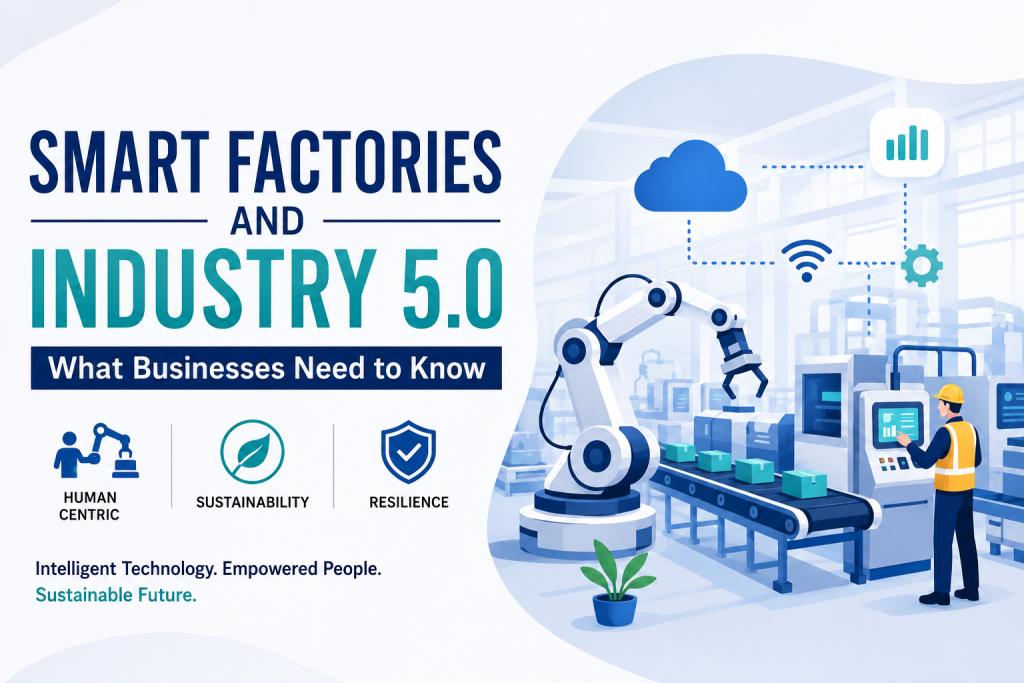
The manufacturing industry is experiencing a major transformation. Smart Factories and Industry 5.0 are changing how products are designed, produced, and delivered. Businesses are now moving beyond traditional automation toward intelligent, connected, and human-centric operations.
While Industry 4.0 focused on digitalization and automation, Industry 5.0 introduces a new vision. It combines advanced technologies with human creativity, critical thinking, and expertise. As a result, manufacturers can achieve greater efficiency, sustainability, and resilience.
Companies that embrace this shift can gain a significant competitive advantage. However, success requires more than advanced technology. It also depends on the quality of the data powering these intelligent systems.
What Is a Smart Factory?
A Smart Factory is a highly connected manufacturing environment where machines, systems, and people communicate seamlessly. It uses technologies such as Artificial Intelligence (AI), Machine Learning (ML), the Internet of Things (IoT), cloud computing, robotics, and advanced analytics.
These technologies collect and process real-time information from production lines. Consequently, manufacturers gain deeper visibility into their operations and can respond faster to challenges.
Smart Factories help businesses:
- Monitor production in real time
- Reduce operational downtime
- Improve product quality
- Increase manufacturing efficiency
- Enhance worker safety
- Optimize resource utilization
- Reduce operational costs
Therefore, organizations can make faster and more accurate business decisions.
Understanding Industry 5.0
Industry 5.0 builds upon the foundation of Industry 4.0. However, its focus extends beyond automation and productivity.
Instead, Industry 5.0 promotes collaboration between humans and intelligent machines. Technology is designed to support workers rather than replace them. As a result, businesses can combine human creativity with machine precision.
Industry 5.0 is driven by three core principles.
Human-Centric Manufacturing
Employees remain at the center of production processes. AI-powered systems and collaborative robots assist workers in completing tasks more efficiently.
Sustainability
Manufacturers are encouraged to reduce waste, minimize energy consumption, and improve environmental performance. Consequently, operations become more sustainable and responsible.
Resilience
Businesses can adapt quickly to market changes, supply chain disruptions, and unexpected challenges. Therefore, long-term operational stability improves.
Key Technologies Driving Smart Factories
Several technologies are enabling the transition toward Industry 5.0.
Artificial Intelligence and Machine Learning
AI and ML analyze vast amounts of manufacturing data. As a result, businesses can identify patterns, automate decisions, and improve productivity.
Internet of Things (IoT)
Connected sensors collect real-time data from equipment and production lines. This information supports monitoring, maintenance, and process optimization.
Robotics and Collaborative Robots
Modern robots can perform repetitive and complex tasks with high accuracy. Meanwhile, collaborative robots work safely alongside human employees.
Digital Twins
Digital twins create virtual representations of physical assets and processes. Therefore, manufacturers can test improvements before implementing them in real environments.
Advanced Analytics
Data analytics helps organizations uncover insights that improve operational performance and support strategic decision-making.
Benefits of Smart Factories and Industry 5.0
Businesses investing in Smart Factory technologies can experience substantial benefits.
Increased Productivity
Automated systems streamline workflows and reduce manual intervention.
Improved Product Quality
AI-powered quality inspection systems identify defects quickly and accurately.
Reduced Downtime
Predictive maintenance helps detect potential equipment failures before they occur.
Better Decision-Making
Real-time data enables managers to make informed decisions faster.
Greater Customer Satisfaction
Efficient manufacturing processes support faster delivery times and higher product quality.
Why High-Quality Data Matters
Data is the foundation of every Smart Factory. AI systems rely on data to learn, predict outcomes, and make decisions.
However, AI models are only as effective as the data used to train them. Poor-quality data can lead to inaccurate predictions, unreliable automation, and costly operational mistakes.
For example, an AI-powered defect detection system requires accurately labeled images. Similarly, predictive maintenance models depend on properly annotated sensor and machine data.
Without reliable training data, even the most advanced AI technologies may fail to deliver expected results.
Therefore, businesses must prioritize data quality throughout their digital transformation journey.
The Role of Data Annotation in Industry 5.0
Data annotation is a critical step in developing intelligent manufacturing systems. It involves labeling raw data so machine learning models can understand and interpret information accurately.
High-quality annotated datasets help AI systems:
- Detect product defects
- Monitor worker safety
- Track inventory and assets
- Improve predictive maintenance
- Support autonomous robotics
- Optimize manufacturing processes
Consequently, organizations can build more reliable and effective AI solutions.
How Infolks Supports Smart Factory Innovation
As businesses adopt Industry 5.0 technologies, the demand for high-quality training data continues to grow.
Infolks provides comprehensive data annotation services that support AI and machine learning applications across industries. Our expertise includes image annotation, video annotation, audio labeling, text annotation, and 3D point cloud annotation.
We help businesses develop intelligent solutions for quality inspection, industrial automation, predictive maintenance, robotics, safety monitoring, and smart manufacturing.
Our experienced annotation teams follow rigorous quality assurance processes to ensure accuracy, consistency, and scalability. As a result, organizations receive reliable datasets that improve AI model performance and business outcomes.
Conclusion
Smart Factories and Industry 5.0 are shaping the future of manufacturing. Businesses that embrace intelligent technologies can improve efficiency, sustainability, and resilience while remaining competitive in a rapidly evolving market.
However, technology alone is not enough. High-quality data remains the key to successful AI adoption and long-term innovation.
Partner with Infolks for High-Quality Training Data
Looking to accelerate your Smart Factory or Industry 5.0 initiatives?
Infolks delivers accurate, scalable, and high-quality data annotation services that power reliable AI and machine learning solutions.
Contact Infolks today and discover how quality training data can transform your manufacturing operations.