
Artificial Intelligence (AI) is transforming the way businesses work. AI assistants can answer questions, write code, automate workflows, and analyze large amounts of information. But despite these advancements, AI has one major limitation: it cannot easily access the tools and business data organizations use every day.
Imagine asking an AI assistant to summarize your latest sales report. The customer data is stored in a CRM, financial records are in an ERP system, and project updates are in another platform. Traditionally, developers had to build separate integrations for each application, making AI deployment time-consuming and expensive.
This is where Model Context Protocol (MCP) comes in.
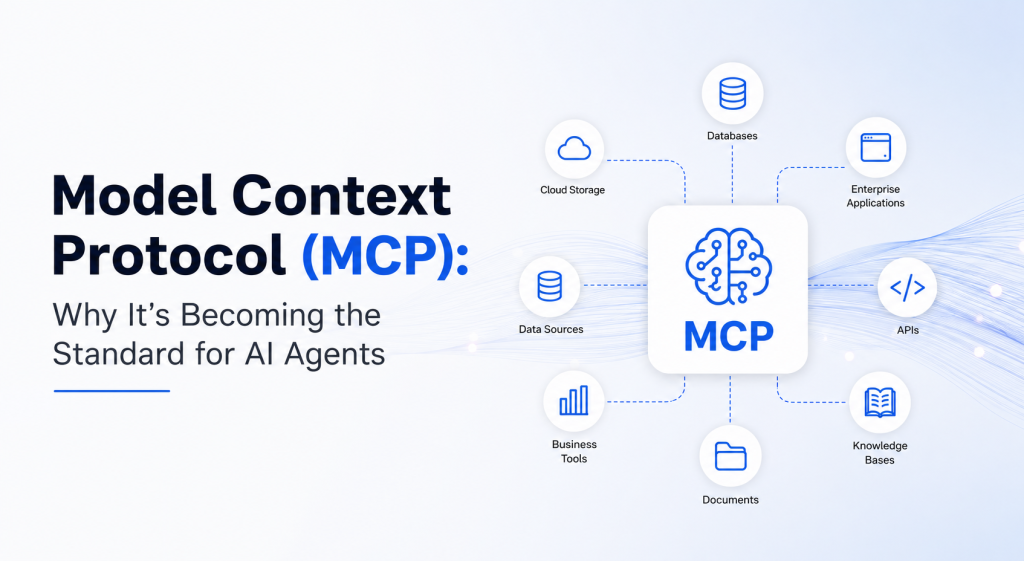
Often called the “USB-C for AI,” MCP is an open standard that allows AI models to securely connect with external tools, databases, APIs, and enterprise applications through a single protocol. Instead of creating custom integrations for every system, developers can use one standardized approach to connect AI with multiple resources.
As AI agents become more common in businesses, MCP is quickly becoming an important technology for building connected and intelligent AI systems.
What Is Model Context Protocol (MCP)?
Model Context Protocol is an open standard that enables AI applications to communicate with external systems consistently and securely.
Think of it like a universal charging cable. Years ago, every device required a different charger. Today, USB-C simplifies connectivity by providing one standard for many devices. MCP brings the same idea to AI by creating a common way for AI models to access business applications and data.
Instead of building a different integration for every platform, organizations can use MCP to simplify AI connectivity and improve scalability.
Why Is MCP Important?
Large Language Models (LLMs) are powerful, but they only know what they were trained on or what is shared during a conversation. They cannot automatically access live business information such as the following:
- Customer records
- Internal documents
- Inventory databases
- Financial reports
- Company knowledge bases
- Project management tools
Without this information, AI often provides generic answers.
MCP solves this challenge by allowing AI agents to retrieve relevant data from trusted systems before generating a response. This makes AI more useful for enterprise applications where accurate, real-time information is essential.
How Does MCP Work?
MCP consists of three key components.
MCP Host – The AI application that users interact with, such as a chatbot or AI assistant.
MCP Client – The component that sends requests between the AI model and external systems.
MCP Server – The connection point that provides secure access to databases, APIs, cloud storage, enterprise software, and other business resources.
When a user asks a question, the AI retrieves the required information through the MCP server before generating its response. This allows AI to work with current business data rather than relying only on pre-trained knowledge.
Benefits of Model Context Protocol
MCP offers several advantages for organizations adopting AI.
- Simplified Integration: One standard replaces multiple custom integrations.
- Real-Time Data Access: AI can retrieve the latest business information whenever needed.
- Better Scalability: Businesses can connect new applications without rebuilding AI workflows.
- Improved Security: Organizations maintain greater control over how AI accesses sensitive information.
- Faster AI Development: Developers spend less time building integrations and more time improving AI capabilities.
Real-World Applications
MCP is already proving valuable across industries.
Healthcare: AI assistants can securely retrieve patient records and appointment information.
Finance: AI can analyze customer accounts, compliance documents, and financial transactions.
Retail: AI shopping assistants can access inventory, pricing, and order status in real time.
Software Development: AI coding assistants can interact with repositories, documentation, and issue-tracking systems.
Enterprise Knowledge Management: Employees can search company documents and policies using conversational AI instead of manually browsing files.
Why Data Quality Still Matters
While MCP improves how AI connects with information, it does not improve the quality of that information.
An AI model is only as reliable as the data it receives. If the connected data is outdated, inconsistent, or poorly organized, AI may generate inaccurate or misleading responses.
This is why successful AI projects depend on accurate data labeling, high-quality annotation, human quality assurance, well-structured datasets, and reliable metadata. Together, these elements enable AI systems to understand context, retrieve relevant information, and deliver accurate, trustworthy results.
These elements help AI understand context, retrieve relevant information, and deliver more accurate results.
How Data Labeling Supports MCP
MCP allows AI to access external information, but data labeling helps AI understand that information.
Well-annotated datasets improve how AI identifies entities, understands user intent, retrieves relevant content, and reduces hallucinations. Whether developing AI agents, Retrieval-Augmented Generation (RAG) systems, or enterprise copilots, quality data remains the foundation of reliable AI.
Building Reliable AI with Infolks
As organizations adopt technologies like MCP, the importance of high-quality training data continues to grow. Connectivity alone is not enough—AI also needs clean, structured, and accurately annotated data to perform effectively.
At Infolks, we support businesses developing AI through high-quality image, video, audio, text, and 3D point cloud annotation services. Our rigorous quality assurance processes help organizations build dependable AI solutions across industries such as healthcare, automotive, manufacturing, retail, logistics, finance, and agriculture.
By combining quality training data with emerging technologies like MCP, businesses can create AI systems that are more accurate, scalable, and ready for real-world applications.
Conclusion
Model Context Protocol is changing the way AI agents interact with enterprise systems. By providing a standardized method for connecting AI with external tools and data sources, MCP simplifies development while making AI more practical for everyday business use.
However, successful AI depends on more than seamless connectivity. High-quality data, accurate annotation, and human expertise remain essential for building trustworthy AI systems.
As AI continues to evolve, combining technologies like MCP with reliable training data will help organizations unlock the full potential of intelligent, connected AI.