
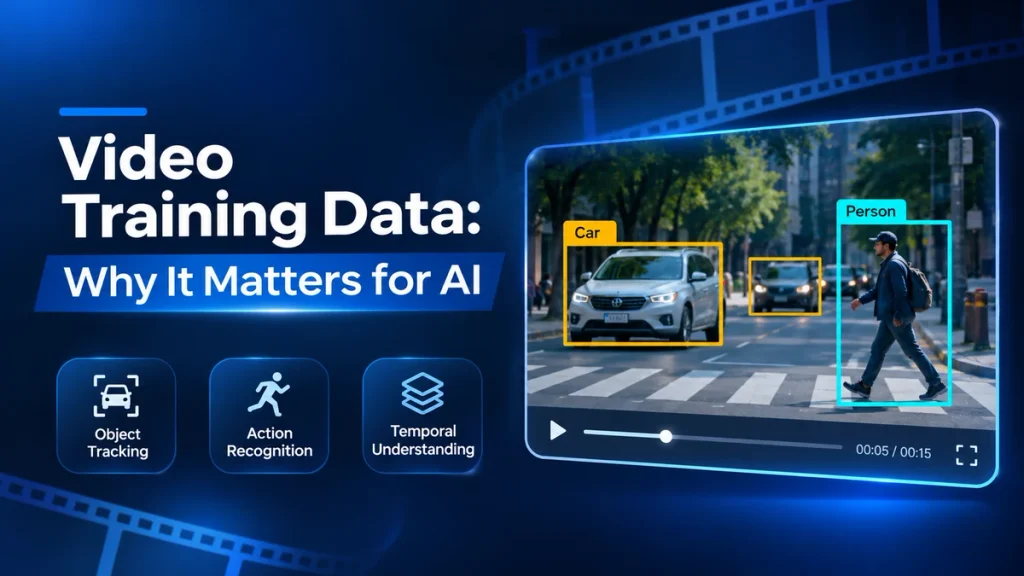
Artificial intelligence has made significant progress in understanding visual information. Modern computer vision systems can identify objects, segment images, recognize faces, and detect patterns with impressive accuracy. However, many real-world applications require AI to understand more than what appears in a single frame.
Video Training Data helps AI systems understand not only what is happening in an environment but also how events develop over time.
A single image provides a snapshot of an environment. In contrast, a video shows a sequence of events. This difference is becoming increasingly important as AI moves into applications such as autonomous vehicles, robotics, drones, industrial automation, and intelligent surveillance.
These systems need to understand how objects move, how people behave, how environments change, and how different events unfold. As a result, video is becoming an increasingly important training data source for AI models that operate in dynamic environments.
1. Why AI Is Moving Beyond Static Images
Traditional computer vision models have largely focused on spatial understanding. In other words, they identify what’s in an image and where it is located.
This approach works well for tasks such as object detection and image classification. However, spatial information alone is not enough when an AI system needs to interpret a changing environment.
Consider an autonomous vehicle approaching an intersection. Identifying a pedestrian in a single frame is useful. However, that image does not tell the system whether the pedestrian is standing still, walking toward the road, crossing the street, or changing direction.
These details become clear only when the system analyzes multiple frames over time.
Video therefore introduces an additional dimension to AI training: time. Instead of learning only what objects look like, models can also learn how objects and environments behave and change.
As a result, temporal understanding is becoming essential for AI systems that need to make decisions in real-world environments.
2. What Video Training Data Adds to AI Models
The main advantage of video is not simply the number of images it contains. Instead, its value comes from the relationships between those frames.
A video sequence can provide information about:
- Object appearance and position
- Movement and direction
- Changes in object states
- Human activities
- Interactions between objects
- Event sequences
- Environmental changes
- Motion patterns and trajectories
For example, an image may show a person standing beside a machine. However, a video sequence can reveal whether the person is approaching the machine, operating it, inspecting it, or moving away.
This additional context gives AI models information that cannot be reliably understood from a single frame.
Furthermore, applications involving physical interaction need more than object recognition. An AI system may need to recognize what is present, understand what is happening, and identify how a situation is developing.
3. Temporal Understanding: How AI Learns Change Over Time
One of the most important concepts in video-based AI is temporal understanding.
Temporal understanding refers to the ability of an AI model to interpret information across a sequence of frames and identify meaningful changes over time.
Rather than analyzing every frame independently, a model can use temporal context to determine:
- What happened before an event
- What is happening currently
- How an object is moving
- How one action relates to another
- When an event starts and ends
- How a scene is likely to develop
This capability matters because many activities cannot be accurately understood from a single visual snapshot.
For instance, a manufacturing camera may capture a worker interacting with a machine. A single frame might show the worker near the equipment. However, the complete sequence could reveal an abnormal operating procedure or a specific action that needs to be detected.
By considering the sequence rather than an isolated frame, AI systems can better distinguish between these situations.
For a practical example of AI-powered video analysis, explore Google Cloud Video Intelligence.
4. From Object Detection to Behavior Understanding
Video-based AI extends beyond identifying objects. It allows models to analyze actions, activities, interactions, and behavioral patterns.
Object detection answers a relatively simple question:
What is in the scene?
Video understanding introduces more complex questions:
What is happening?
What has changed?
How are the objects interacting?
What action is taking place?
For example, recognizing a cyclist is an object detection task. However, determining that the cyclist is approaching an intersection, changing direction, and moving into the path of another vehicle requires temporal information.
This is where tasks such as action recognition and activity recognition become important.
Depending on the application, training datasets may need to capture:
- Human actions
- Object interactions
- Pose and keypoints
- Movement trajectories
- Activity sequences
- Event boundaries
- Spatial relationships
These labels help models learn patterns that extend beyond simple object recognition. Consequently, accurate video annotation plays an important role in building datasets for behavior understanding.
5. Object Tracking: Maintaining Context Across Frames
Another important component of video understanding is object tracking.
Detection identifies an object in an individual frame. In comparison, tracking maintains information about that object as it moves through a sequence.
For example, in a traffic video, a system may detect several vehicles in the first frame. As those vehicles move, the model needs to determine which vehicle in the next frame corresponds to each previously detected vehicle.
However, this process becomes more difficult when objects:
- Move quickly
- Overlap with other objects
- Become partially or completely occluded
- Change direction
- Enter or leave the camera’s field of view
- Appear under different lighting conditions
Therefore, tracking requires consistent identification across time.
High-quality tracking data can help AI systems learn trajectories, movement patterns, and interactions between multiple objects.
For applications such as autonomous driving and robotics, this information is critical. Decisions often depend on how an object is moving rather than simply where it is located.
You can also explore the Google Cloud Video Intelligence documentation for further information about automated video analysis capabilities.
6. Why Video Data Annotation Is More Complex
Video provides richer information than static images. At the same time, that additional information makes video annotation more complex.
A short video can contain hundreds or thousands of frames. Annotators may need to maintain consistent object identities, locations, actions, and attributes throughout the sequence.
One of the biggest challenges is temporal consistency.
For example, if a vehicle is labeled in one frame, its identity should remain consistent as it moves across subsequent frames. Similarly, if a person becomes partially hidden behind another object, the annotation needs to account for the temporary occlusion without breaking the object’s identity.
Video datasets may require several levels of annotation.
Frame-Level Annotation
Individual frames can be labeled using bounding boxes, polygons, segmentation masks, or keypoints. This helps AI models identify objects and their visual characteristics.
Track-Level Annotation
Objects are linked across multiple frames so that their movement and identity can be followed throughout the sequence.
Event-Level Annotation
Specific activities or events are marked according to when they begin, continue, and end. This helps models understand the timing of actions.
Ultimately, the required annotation approach depends on the AI model and the task it is designed to perform.
Professional video annotation services help create structured datasets by labeling objects, tracking movement, and identifying activities across video frames.
7. Training AI for Real-World Variations
A model trained on predictable and controlled video may perform well during testing. However, it can struggle when exposed to real-world conditions.
Real environments are rarely consistent. Therefore, video datasets may need to represent variations in:
- Lighting
- Weather
- Camera position
- Camera movement
- Object appearance
- Crowd density
- Background environments
- Occlusion
- Motion blur
- Unusual or rare events
For autonomous systems, these variations are particularly important. For example, a model trained mainly on clear daytime footage may not perform equally well in rain, fog, low light, or heavy traffic.
This is why dataset design matters just as much as annotation accuracy. Training data needs to represent the range of situations an AI system is expected to encounter after deployment.
The objective is not simply to collect more video. Instead, the goal is to build a dataset that meaningfully covers the target environment.
8. Video, 3D, and Multimodal Training Data
Video is becoming even more valuable when combined with other types of training data.
Modern AI systems can process multiple modalities, including:
- Images and video
- Text
- Audio
- Depth information
- LiDAR
- 3D point clouds
- Sensor data
Combining these sources can provide a more complete representation of an environment.
For example, video provides visual and temporal information, while LiDAR can provide spatial and depth information. In addition, audio may offer context about an event that is not visually obvious.
However, combining different data sources requires accurate alignment.
If a video frame and a LiDAR point cloud represent the same scene, their timing and spatial relationships need to be consistent for the combined dataset to be useful.
This requirement is becoming increasingly relevant for robotics, autonomous vehicles, and other physical AI applications that rely on multiple sensors to understand their surroundings.
9. Synthetic Video and Simulation for AI Training
Real-world data is valuable. Nevertheless, collecting enough examples of rare or difficult situations can be expensive and time-consuming.
For this reason, synthetic data and simulation are receiving increased attention in AI development.
Synthetic environments can generate controlled scenarios that may be difficult to capture in the real world. These scenarios can include unusual traffic situations, dangerous industrial events, extreme environmental conditions, or specific robot interactions.
Moreover, simulation gives developers greater control over variables such as object placement, lighting, weather, camera position, and movement.
However, synthetic data does not automatically solve every training problem. A model trained primarily on simulated environments may encounter differences when deployed in the real world. This challenge is commonly known as the sim-to-real gap.
Therefore, synthetic data is often most useful when combined with carefully selected real-world data.
10. Why Video Training Data Matters for Physical AI
The growing importance of video is closely connected to the development of AI systems that operate in physical environments.
Robots, autonomous vehicles, drones, and industrial systems need to understand their surroundings continuously rather than analyze isolated images.
For example, a robot working alongside people may need to recognize a person’s movement, understand the position of nearby objects, and respond to changes in the environment.
Similarly, an autonomous vehicle needs to interpret the movement of surrounding vehicles and pedestrians while continuously updating its understanding of the road.
These applications require training data that captures space, time, movement, and interaction.
Video provides an important foundation for developing this type of temporal understanding. As physical AI advances, the demand for well-structured video training datasets is also likely to grow.
11. Applications of Video Training Data
Video training data supports several AI applications where understanding movement and events is essential.
Autonomous Vehicles
Video data helps models understand road users, vehicle movement, traffic behavior, and changing road conditions. As a result, AI systems can learn from sequences of road events rather than isolated images.
Robotics
Robotic systems can use video to learn about object manipulation, human activities, movement, and interactions within physical environments.
Manufacturing
Video can support visual inspection, process monitoring, anomaly detection, worker activity analysis, and quality control. In addition, it can help identify events that occur during production.
Drones
Video data helps AI systems interpret terrain, track objects, detect movement, and respond to changing environments.
Warehousing and Logistics
Video can support object tracking, worker movement analysis, inventory processes, and automated monitoring.
Healthcare and Assistive AI
Video can be used for activity recognition, movement analysis, rehabilitation monitoring, and other applications where understanding human actions over time is important.
Across these industries, the common requirement is the ability to interpret sequences rather than isolated visual snapshots.
12. Building Video Training Data for AI Systems
The effectiveness of a video dataset depends on how well it represents the task the AI system needs to perform.
A typical workflow can involve:
Raw Video → Data Selection → Annotation → Quality Control → Structured Dataset → Model Training → Evaluation
First, relevant video is selected according to the target use case. Next, the footage is annotated based on the model’s requirements. These requirements may include object detection, tracking, segmentation, pose estimation, action recognition, or temporal event labeling.
After annotation, quality control helps identify errors and maintain consistency across the dataset.
This step is particularly important for video because an annotation error can affect multiple frames within a sequence. Dataset teams may also need to review edge cases, maintain temporal consistency, and verify that different annotation types remain aligned.
The result is not simply a collection of labeled videos. Instead, it is a structured dataset designed to provide the information an AI model needs to learn a specific capability.
13. How INFOLKS Supports Video AI, Training Data
As AI models become more capable of understanding dynamic environments, their training data requirements also become more specialized.
This creates a need for annotation workflows that preserve information across frames while maintaining consistency in objects, actions, spatial relationships, and events.
INFOLKS works with AI training data across computer vision and related applications. Its data annotation workflows support requirements involving video annotation, object tracking, segmentation, pose and keypoint annotation, and other data-labeling tasks.
For organizations developing robotics, autonomous systems, industrial AI, and computer vision solutions, the focus is not simply on labeling individual frames. Instead, the dataset needs to reflect the specific visual and temporal information required by the model.
By structuring training data around these requirements, annotation becomes an important part of the model-development process rather than a separate labeling step.
Explore INFOLKS AI data annotation solutions to learn more about its services and capabilities.
Conclusion
Video is becoming an important part of AI training because many intelligent systems need to understand how the world changes, not just what it looks like.
The shift toward temporal understanding is particularly significant for robotics, autonomous vehicles, industrial automation, and other applications that operate in dynamic environments. These systems need information about movement, actions, object relationships, and events unfolding over time.
As AI development progresses, the challenge will increasingly move from collecting large amounts of visual data to creating datasets that accurately represent the temporal and spatial complexity of real-world environments.
For organizations building the next generation of computer vision and physical AI systems, well-structured video training data can provide an important foundation for developing models that understand dynamic situations.
Frequently Asked Questions
What is video data annotation?
Video data annotation is the process of labeling objects, actions, events, movements, and other relevant information across video sequences so that AI and machine learning models can learn from them.
Why is video training data important for AI?
Video training data provides temporal information that static images cannot. It allows AI models to learn movement, actions, object interactions, and changes within an environment.
What is temporal annotation?
Temporal annotation identifies activities, events, or changes across a specific period in a video rather than focusing only on individual frames.
What is the difference between image annotation and video annotation?
Image annotation focuses on information within a single image. In contrast, video annotation can capture movement, object tracking, actions, interactions, and events across multiple frames.
What is object tracking in video annotation?
Object tracking involves maintaining the identity and location of an object across multiple frames in a video sequence.
Why is video annotation more complex than image annotation?
Video annotation requires consistency across time. Annotators may need to track objects, handle occlusion, identify actions, mark events, and maintain accurate labels across many frames.
How is video data used in robotics?
Video training data helps robotic systems understand movement, human activities, object interactions, and changes in their surrounding environment.
Can synthetic video replace real-world training data?
Synthetic video can provide controlled and scalable training examples. However, differences between simulated and real environments can affect model performance. Therefore, many applications use synthetic and real-world data together.