
Artificial intelligence has made significant progress in understanding different types of information. Language models can process large volumes of text, while computer vision systems can identify objects, analyze images, and detect patterns in visual data. However, real-world environments are much more complex than individual documents or images.
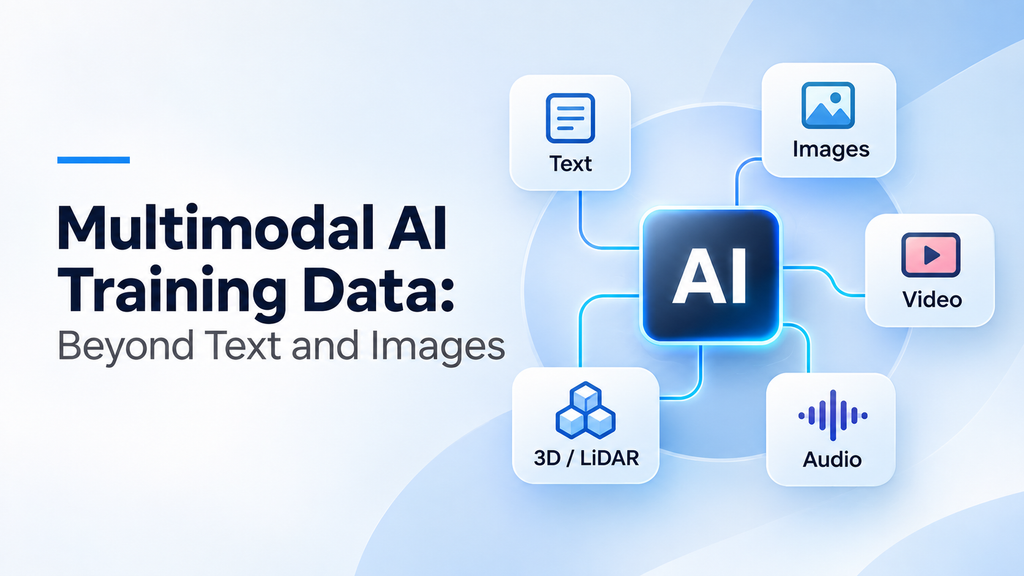
Multimodal AI training data is becoming increasingly important as organizations develop AI systems that need to understand the world through multiple sources of information. These sources include text, images, video, audio, 3D point clouds, and sensor data.
For example, an autonomous vehicle approaching a busy intersection must identify vehicles and pedestrians, interpret traffic signals, estimate movement, and recognize road conditions. In addition, it may need to detect sounds such as an approaching emergency vehicle.
By combining these different inputs, multimodal AI systems can develop a better understanding of their surroundings. Consequently, AI development is moving beyond isolated object recognition toward contextual understanding, decision-making, and real-world interaction.
What Is Multimodal AI Training Data?
Multimodal AI refers to artificial intelligence systems that can process and connect multiple types of information, also known as modalities.
Multimodal AI training data consists of different information sources that are collected, annotated, and aligned to train AI models. Depending on the application, these modalities can include:
- Text and natural language
- Images
- Video
- Speech and audio
- Depth information
- 3D point clouds
- LiDAR data
- Sensor data
- Human movement and pose
- Robot actions and states
Each modality provides a different perspective on the same environment. For instance, images provide visual information, while video adds movement and temporal context. Similarly, audio captures speech and environmental signals, whereas 3D data provides information about depth, position, and spatial relationships.
However, simply combining different data types is not enough. AI systems must also understand how these inputs relate to one another.
Consider a robot receiving the instruction, “Move the component beside the machine.” To complete this task, it needs to understand the language instruction, identify the correct component, locate the machine, recognize the spatial relationship between them, and determine an appropriate movement.
Therefore, language, visual information, spatial data, and resulting actions must work together. This ability to connect different forms of information makes multimodal AI valuable for complex applications.
For a broader understanding, explore Google Cloud’s overview of Multimodal AI.
From Object Recognition to Understanding Situations
Object recognition has been a fundamental capability in computer vision. AI models can identify vehicles, products, people, road signs, medical abnormalities, and many other objects.
However, identifying an object is only the first step in many real-world applications.
For example, consider a warehouse robot. Recognizing a package does not tell the robot whether the package is ready for pickup, whether another worker is approaching, whether the route is blocked, or where the package needs to be placed.
Instead, the system must understand relationships between objects, actions, and the surrounding environment.
This creates an important distinction between recognizing a state and understanding a change in state.
A single image may show a worker standing beside a machine. In contrast, a sequence of video frames can show the worker approaching the machine, opening a panel, interacting with a component, and completing an operation.
As a result, the second scenario provides information about the entire event rather than simply identifying objects within an image.
For organizations developing computer vision applications, explore INFOLKS Image Annotation Services to learn about labeled image datasets for object detection, classification, segmentation, and other computer vision tasks.
For AI systems operating in dynamic environments, this transition from object recognition to event and context understanding is essential.
Why Video Matters in Multimodal AI Training
Images represent individual moments, whereas video captures how those moments are connected over time.
This temporal information is particularly important when AI systems need to understand actions, processes, or changes within an environment.
Consider an industrial assembly task. A model may need to understand that a component was picked up, rotated, positioned against another part, secured, and inspected. Although the final frame shows the result, it does not explain how the result was achieved.
In comparison, video training data captures the complete sequence and provides information about:
- When an action starts and ends
- How objects move between frames
- Which action follows another
- How an object’s state changes
- How people and machines interact
- How long an event takes
Furthermore, this temporal information allows models to learn patterns across sequences rather than treating every frame as an independent image.
Through INFOLKS Video Annotation Services, AI development teams can explore video labeling solutions for identifying objects, tracking movements, and annotating activities across video frames.
For robotics, autonomous vehicles, industrial automation, and other dynamic applications, understanding what happened, what is happening, and what may happen next can be more valuable than identifying objects alone.
How Audio Adds Context That Vision Cannot Provide
Visual data does not always provide enough information to understand an environment. Audio can offer additional context that cameras alone may miss.
For example, an autonomous vehicle may detect traffic through cameras, while an approaching emergency vehicle can be identified through its siren. Similarly, unusual machine sounds can provide additional signals when monitoring equipment in manufacturing environments.
Speech also provides an important layer of context.
Consider a spoken instruction such as, “Move the red container next to the conveyor.” To understand this command, an AI system must interpret the language, identify the referenced container, locate the conveyor, and recognize the intended spatial relationship.
After that, the system needs to connect the instruction to an appropriate action.
This demonstrates why audio and language are more than additional data sources. They help AI systems interpret the meaning of information captured through other modalities.
Organizations working with speech recognition and sound classification can explore INFOLKS Audio Annotation Services to understand how audio data can be labeled for AI and machine learning applications.
How 3D Data Improves Spatial Understanding
Understanding an environment also requires spatial awareness.
A 2D image can indicate where an object appears within a frame. However, it may not provide enough information about actual depth, distance, orientation, or relationships with surrounding objects.
This is where 3D data, depth information, LiDAR, and point clouds become important.
A point cloud represents an environment using spatial points that describe its three-dimensional structure. AI systems can use this information to understand object positions, geometry, and relationships with the surrounding environment.
For instance, a warehouse robot may need to determine:
- Where a package is located
- How far the package is from the robot
- Which obstacles are nearby
- Whether there is enough space to move
- How the package is oriented
- Where the robot should position itself to interact with it
Consequently, 3D data is particularly valuable for robotics, autonomous vehicles, industrial automation, mapping, and inspection applications.
To prepare spatial datasets for these applications, explore INFOLKS LiDAR Annotation Services, which focus on labeling 3D point cloud data for AI and machine learning.
The Real Challenge: Connecting Different Data Types
Collecting multiple types of data is only the beginning. One of the biggest challenges in multimodal AI training is ensuring that different data sources are correctly connected.
Consider a dataset containing video of a worker assembling a component, audio of the worker describing the process, and 3D sensor data capturing the workspace.
For an AI model to learn effectively, these sources must correspond to the same events and be accurately aligned.
This process involves several important forms of alignment.
Temporal Alignment
Different data sources need to correspond to the correct point in time. For example, a spoken instruction should be linked to the relevant action in the video.
Spatial Alignment
Information from different sensors needs to correspond to the same physical locations and objects. This helps AI systems understand how different data sources represent the same environment.
Semantic Alignment
Words, objects, actions, and events need to be connected according to their meaning and role within a task. As a result, the model can learn meaningful relationships between different modalities.
Action Alignment
For robotics and embodied AI, the system may also need to connect what it perceives with the action that follows.
Together, these relationships make multimodal annotation considerably more complex than labeling individual objects.
For additional technical information about organizing multimodal datasets, explore Google Cloud’s multimodal AI documentation.
What Multimodal AI Training Data Needs to Capture
The exact requirements depend on the AI application. Nevertheless, a multimodal training dataset can contain several important layers of information.
Object Annotations: These identify and classify relevant objects in images, videos, or 3D scenes.
Tracking Annotations: These maintain object identities across video frames so that models can learn movement and continuity.
Action Annotations: These describe what people or machines are doing within a particular environment.
Temporal Annotations: These identify when events begin, end, or change throughout a sequence.
Pose and Keypoint Annotations: These capture body, hand, or joint positions when human movement is relevant.
Interaction Annotations: These describe relationships such as a person holding an object, a robot picking up a component, or two parts being assembled.
3D Annotations: These capture spatial properties such as position, orientation, depth, and relationships between objects.
Language and Audio Annotations: These can include speech transcription, spoken commands, sound events, and their relationships with visual events.
Together, these annotation layers provide a more complete representation of the environment and the tasks being performed.
For language-based AI applications, explore INFOLKS Text Annotation Services to learn about preparing structured text datasets for natural language processing and machine learning.
Why Data Quality Matters More in Multimodal AI
As datasets become more complex, data quality becomes more than a question of whether individual labels are accurate.
A dataset may contain millions of examples and still produce poor training results if its annotations are inconsistent, incomplete, or incorrectly aligned.
For example, an object may be tracked accurately throughout a video. However, if the associated action is assigned to the wrong time interval, the model may learn an incorrect relationship.
Similarly, if a spoken instruction is linked to the wrong object or event, the training data can introduce misleading associations.
Data diversity is equally important.
AI systems deployed in real-world environments encounter different lighting conditions, camera angles, environments, object appearances, human behaviors, background sounds, weather conditions, and unexpected situations.
Therefore, training datasets need to represent the range of conditions that models are expected to handle.
For B2B AI development teams, this means evaluating training data based on accuracy, consistency, alignment, coverage, and diversity, rather than focusing only on dataset volume.
Explore INFOLKS AI Data Annotation Services to learn more about annotation solutions for AI and machine learning projects.
From Multimodal Perception to AI Action
The importance of multimodal training becomes even clearer when AI systems are expected to interact with the physical world.
A typical workflow can be represented as:
Perception → Context → Reasoning → Decision → Action
First, the system gathers information through cameras, microphones, 3D sensors, language instructions, or other sources. Next, it combines these inputs to understand the current situation.
Based on that context, the AI system can determine an appropriate response. Where applicable, it can then pass the decision to a control system or robotic mechanism.
This approach is particularly relevant to embodied AI, which focuses on AI systems that perceive and interact with physical environments.
Unlike systems that only process digital information, embodied AI systems must respond to changes in their surroundings. Consequently, their training data needs to represent more than what an environment looks like.
It must also capture how the environment changes, how objects interact, what people or machines are doing, and how actions affect the surrounding environment.
This is where multimodal training data becomes closely connected to AI systems that need to move from perception and understanding to action.
Where Multimodal AI Is Creating Business Value
The need for multimodal understanding is growing across different industries. Organizations are exploring these capabilities to develop AI systems that can interpret complex environments and support real-world applications.
Robotics
Robots can combine visual information, language instructions, depth, sensor data, and action information to perform tasks in warehouses, manufacturing facilities, laboratories, and other controlled environments.
Autonomous Vehicles
Autonomous systems can combine camera feeds, LiDAR, radar, maps, and other sensor information to understand roads, vehicles, pedestrians, and changing traffic conditions.
Manufacturing
Video, machine sounds, sensor data, and production information can help AI systems monitor processes, identify anomalies, and understand operational events.
Drones
Drones can combine visual and spatial information to navigate environments, inspect infrastructure, map locations, and respond to changing conditions.
Healthcare
Depending on the use case, AI systems can combine medical images, clinical text, audio, and other information to support analysis and decision-making while meeting applicable regulatory requirements.
Across these applications, the business challenge is not simply acquiring more data. Instead, organizations need structured, reliable, and relevant training data that reflects the conditions in which their AI systems will operate.
How INFOLKS Supports Multimodal AI Training
As AI applications become more complex, the data pipeline supporting them must evolve as well.
Projects involving robotics, computer vision, autonomous systems, and multimodal AI can require different combinations of image, video, audio, text, and 3D data. Preparing these datasets requires annotation processes that maintain accuracy and consistency across modalities.
INFOLKS supports AI and machine learning teams with annotation across image, video, audio, text, and 3D point cloud data.
The focus is on transforming raw data into structured training datasets based on the requirements of each AI application. Depending on the project, this can involve:
- Identifying and classifying objects
- Tracking activities across video frames
- Capturing temporal events
- Documenting spatial relationships
- Annotating 3D point cloud information
- Labeling audio and speech data
- Structuring text for language-based AI applications
- Connecting information across different modalities
Furthermore, annotation quality and consistency are important when preparing datasets for complex AI applications.
For organizations developing AI systems for real-world environments, reliable training data can help models learn the patterns and relationships needed to perform their intended tasks.
Explore INFOLKS AI Data Annotation Services to learn more about image, video, text, audio, LiDAR, and other data annotation solutions.
The Future of AI Training Is About Context
Text and images will remain important components of AI training. However, AI systems designed to operate in dynamic and physical environments need a broader understanding of the world.
They must process language, vision, audio, movement, spatial information, and sensor data while understanding how these inputs relate to one another.
As a result, AI training is shifting from isolated labels toward context-rich and interconnected training data.
For businesses developing robotics, autonomous systems, industrial AI, and other advanced applications, the ability to build reliable multimodal datasets will become an increasingly important part of AI development.
Ultimately, the future of AI training is not simply about teaching machines to see or read. It is about giving them the context they need to understand situations, make informed decisions, and support appropriate actions.
Frequently Asked Questions
What is multimodal AI?
Multimodal AI refers to artificial intelligence systems that can process and connect multiple types of information, including text, images, video, audio, 3D data, and sensor information.
Why is multimodal AI important for businesses?
Many business applications involve complex environments where no single data type provides enough information. Therefore, multimodal AI can combine different inputs to improve contextual understanding and support more capable AI systems.
Why is video important for AI training?
Video provides temporal information that individual images cannot capture. It allows models to learn movement, actions, event sequences, object trajectories, and changes in state over time.
What is multimodal data annotation?
Multimodal data annotation involves labeling different types of training data while maintaining the relationships between them. This can include objects, actions, events, language, audio, spatial information, and interactions.
Why is 3D data important for AI?
3D data provides information about depth, position, orientation, and spatial relationships. It is particularly useful for applications such as robotics, autonomous vehicles, industrial automation, mapping, and inspection.
Why is data alignment important in multimodal AI?
Data alignment ensures that information from different modalities corresponds to the same objects, events, locations, and actions. Without proper alignment, AI models may learn incorrect relationships.
How does annotation support robotics and embodied AI?
Annotation converts raw sensor, image, video, audio, and other data into structured training examples. These examples can capture objects, actions, movement, interactions, and spatial relationships that help models learn how to operate in physical environments.
Which industries can benefit from multimodal AI?
Multimodal AI can support applications in robotics, autonomous vehicles, manufacturing, healthcare, logistics, drones, industrial automation, and other industries where AI needs to interpret information from multiple sources.
Conclusion
Artificial intelligence is moving from isolated perception toward a more connected understanding of the world.
Text and images remain foundational, but advanced AI systems increasingly need video, audio, 3D information, sensor data, language, and action data to understand dynamic environments.
For organizations developing these systems, the priority is not simply collecting larger datasets. Instead, it is building accurate, diverse, and well-aligned training data that represents the relationships within real-world environments.
That foundation can help AI move beyond recognizing individual inputs toward understanding situations and supporting real-world decisions and actions.
INFOLKS – Building Smarter AI Through Quality Training Data.
#AI #ArtificialIntelligence #MultimodalAI #MachineLearning #DataAnnotation #TrainingData #ComputerVision #Robotics #3DData #AITraining